


Uncategorized
16 Minute
BLOG 02 5 Proven Secrets to The Complete SaaS Marketing Funnel Guide: From Awareness to Paid Customer

Most SaaS companies don’t have a marketing problem. They have a funnel problem. Traffic exists. Signups happen. But somewhere between the first click and the credit card, people disappear — and most founders have no idea where or why. This guide walks through every stage of the SaaS marketing funnel, what should be happening at each stage, and the specific levers you can pull to improve conversion throughout.
Why the SaaS Marketing Funnel Is Different from Everything Else
Selling software is fundamentally different from selling physical products. There’s no impulse purchase. No instant gratification. SaaS buyers research, compare, trial, and evaluate — often over weeks or months — before making a decision. For more information on digital growth, you can check out this SEO guide.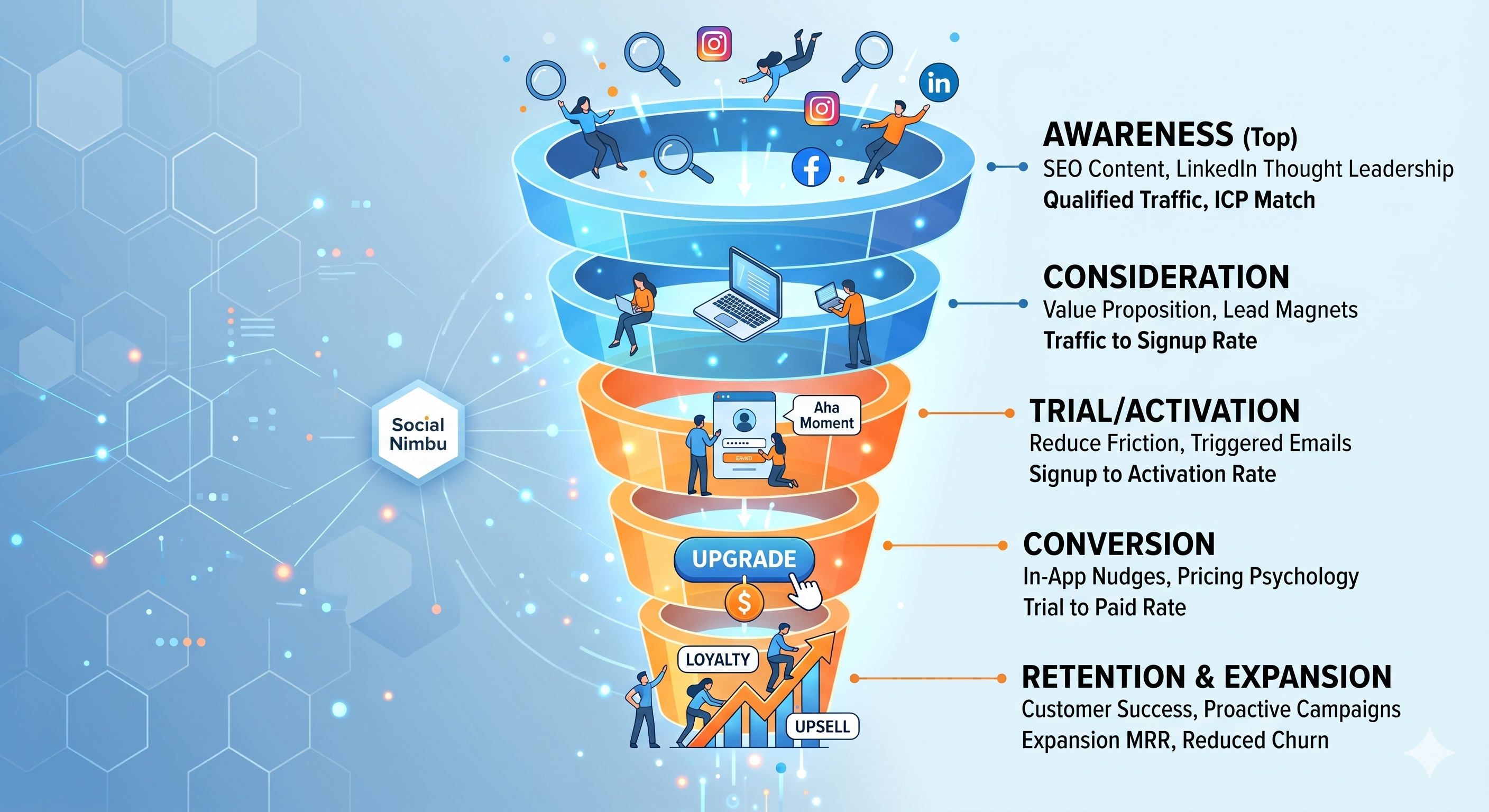 This means your marketing funnel has to do more than generate awareness and convert. It has to educate, build trust, reduce friction at every stage, and continue delivering value after the sale. The funnel doesn’t end at purchase. For SaaS, it never really ends.
The 5 Stages of a High-Converting SaaS Marketing Funnel
Stage 1: Awareness — Getting Found by the Right People
Awareness is about being in the right place when your ideal customer is looking. For SaaS, that means showing up in Google when someone searches for a problem your product solves, being present on LinkedIn where your buyers consume content, and being mentioned in communities and review sites where your audience does research. The most sustainable awareness channels for SaaS in 2025 are SEO-driven content, LinkedIn thought leadership, and word of mouth from existing customers. Paid channels work too, but they stop the moment you stop paying. Build at least one organic awareness channel that compounds over time.
Stage 2: Consideration — Turning Strangers into Prospects
Once someone lands on your site or engages with your content, the question is: can you capture enough interest to move them further? This is where most SaaS companies fail — they optimize for traffic but neglect what happens after the click. At the consideration stage, your job is to communicate your value proposition clearly and quickly. Visitors decide within 5 seconds whether to stay or leave. Your headline needs to answer the question “what does this do and who is it for?” without making them think too hard.
Stage 3: Trial/Activation — The Make-or-Break Moment
For most SaaS products, the trial or freemium signup is the most important conversion in the entire funnel. But it’s also where the biggest dropout happens. The average free trial conversion rate for SaaS is somewhere between 15–25%. If yours is below that, the problem is almost certainly activation — users sign up but never experience the core value of your product before they abandon it.
Stage 4: Conversion — Turning Trials into Revenue
The conversion from trial to paid is where the money is. And it’s often left to chance — a generic upgrade prompt in the app, an automated email sequence that nobody reads, and hope. The best SaaS companies treat trial-to-paid conversion as a sales motion, not a marketing automation task. Pricing psychology matters here. The decoy effect — offering three tiers where the middle option is designed to be the obvious choice — consistently outperforms two-tier pricing.
Stage 5: Retention and Expansion — The Stage Most Companies Ignore
In SaaS, the real money isn’t in acquisition — it’s in retention and expansion. A customer who stays for 24 months instead of 6 is worth four times as much. A customer who upgrades to a higher plan is pure margin. Customer success is marketing. Your onboarding experience, your check-in emails, your response time to support tickets — all of these are marketing decisions that determine whether customers stay or churn.
The Metrics That Tell You Where Your SaaS Marketing Funnel Is Broken
Every SaaS funnel has a weak link. Here’s how to find yours:
- Traffic to signup rate below 2%: Your value proposition or landing page isn’t connecting.
- Signup to activation below 40%: Your onboarding isn’t delivering the “aha moment” fast enough.
- Trial to paid below 15%: Users aren’t experiencing enough value to justify paying.
- Monthly churn above 3%: Something is broken post-sale.
Building Your Funnel for 2025
The SaaS marketing funnel in 2025 is AI-augmented, community-driven, and increasingly product-led. The companies growing fastest are those that treat every touchpoint — from the first Google search to the 12-month renewal — as a designed experience. At Social Nimbu, we audit SaaS marketing funnels and identify the highest-leverage fix for every stage. If you want to know where your funnel is leaking and exactly how to fix it, book a free discovery call.
Frequently Asked Questions
How long does it take to see results from a SaaS marketing funnel?
Typically, it takes 3 to 6 months of consistent optimization to see meaningful results in your trial-to-paid conversion rates.
What is the most important metric to track?
While traffic is great, the “Signup to Activation” rate is the make-or-break metric for SaaS growth. Aim for at least 40%.
Can AI help in building the funnel?
Yes, the 2025 SaaS marketing funnel is increasingly AI-augmented, using tools for hyper-personalized outreach and predictive lead scoring.
Tagged with :